Khaled Hosseini
The Kite Runner — Some Thoughts After Finishing It
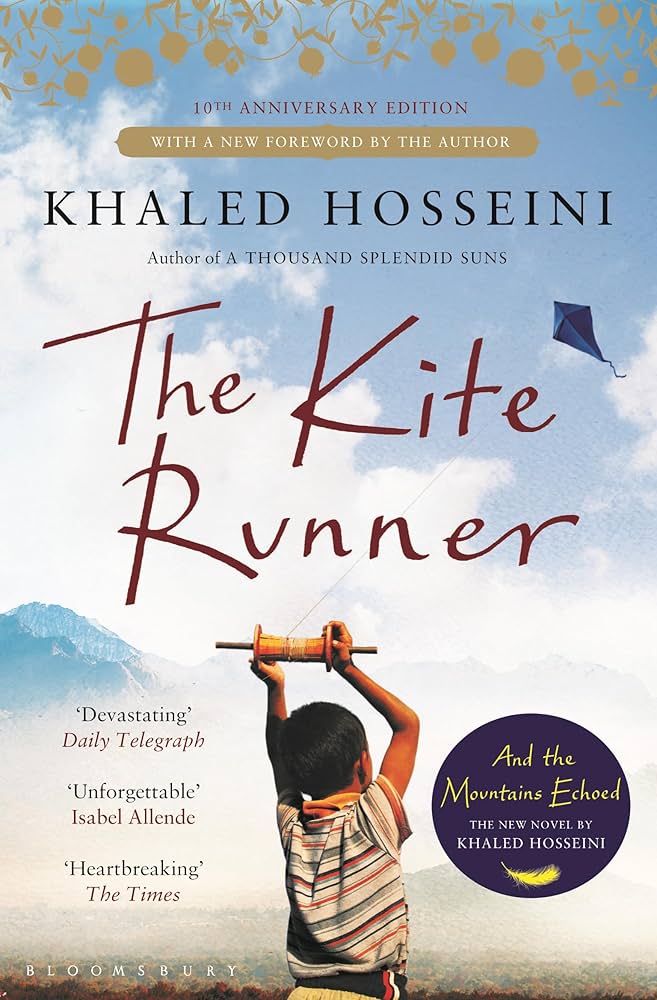
I’ve just finished reading The Kite Runner by Khaled Hosseini and would like to put a few thoughts about the book down.
The story touches on many topics: friendship, betrayal, guilt, redemption, and of course Afghanistan. However, the aspect that interested me most was the relationship between Amir, Hassan, and Baba.
I believe that many people would hold Amir responsible for what took place to Hassan, and that is to an extent entirely justified since what he did was awful. Yet I have forgiven him myself.
The majority of the mistakes we’re referring to were made when he was a child, and I don’t consider it fair to judge a child without taking into account the environment he grew up in.
I actually think that Baba played a big part in what later took place between Amir and Hassan.
All Amir ever wanted was to receive love, affection, and appreciation from his father, and he wanted Baba to be proud of him; yet he never really felt that he was good enough.
In my opinion, those were the source of a great deal of his insecurities.
Amir was not the type of son that Baba had in mind. Baba respected courage, physical strength, and people who defended themselves, whereas Amir liked reading books and writing stories and poetry.
Obviously, there was nothing wrong with any of that, but Amir had the feeling as he grew up that there was.
Can you imagine having to show that you were worthy of your father’s love whenever you were a child?
That is what the kite tournament meant to Amir; it was not merely about winning the competition but was about finally carrying out an action which would enable Baba to be proud of him.
In that state of desperation he reached a horrible decision.
I don’t intend to defend what he did to Hassan since it was wrong, but I can see why a child in his position might have behaved as he did.
That leads me to Baba.
Was Baba a great man?
Ah, in what sense then?
If we come to the subject of courage and those moral values which society has established, then yes, he was a great man; he was respected, generous, courageous and stood by his principles.
In my opinion, that still isn’t sufficient to determine a man’s greatness.
His family relationship is important as well. I think it has a very important role to play.
There’s where Baba made his mistake.
He had two sons and he failed them in different ways.
Amir longed in his childhood for his father’s affection, whereas Hassan lived his life not knowing that Baba was his father.
The most unfortunate thing is that Baba was aware of everything.
He knew that Hassan was his son and that the truth regarding his relationship with Ali’s wife was known to him, but he decided to keep it a secret.
The man who had spoken such praise of honesty and moral principles was not honest on a matter so important in his own life.
And consider the implications of that secrecy for Amir and Hassan.
Amir for many years felt insecure regarding his father’s affection for Hassan, even though he never knew that Hassan was in fact his brother.
On the contrary, Hassan never had the chance to find out the truth regarding his own father.
It is difficult for me to ignore that.
By no means am I suggesting that Baba wasn’t a good person or that all the good things he had done ought to be forgotten. That isn’t the point I’m making.
What I’m getting at is that being respected by society doesn’t always imply that a person has acted justly towards those closest to him.
In my opinion, we shouldn’t ignore that aspect of a person’s life when we’re discussing their greatness.
What concerns me about Amir is that in the end he had the courage to face the consequences of what he had done.
He might have kept on living his life in America, since he had a wife, a career, and a lifestyle which was quite different from all that had taken place in Afghanistan.
But he went back.
I think that it was a form of redemption.
For years he had felt guilty about having betrayed Hassan and now there was a chance for him to take action about it.
It is obvious that saving Sohrab won’t make up for what had occurred to Hassan. Nothing could.
Yet Amir decided to return and confront the thing which he had been running from for so many years.
Because of that, I have respect for him.
It might be said that Amir went back since he found out that Hassan was his half-brother, but I believe that wasn’t the main reason.
I think he would have gone back even if he didn’t know.
Amir did not have to be Hassan’s brother in order to feel guilty about having betrayed him; that sense of guilt had been there for years, long before he found out the truth.
The fact that they were blood relatives didn’t alter what Amir had done, nor did it suddenly make Hassan more worthy of receiving help.
What mattered was that Amir at last decided to take action.
In my opinion, that should be acknowledged.
It is interesting that Baba, the man who had been admired by everyone for his courage, kept a secret which he never had the courage to reveal, whereas Amir, having been a coward when he was a child, eventually gained the courage to face his past.
I’m not asserting that Amir became a greater man than Baba; in fact, I don’t know how one could measure something of that kind.
I do respect Amir for the man he in the end became.
The thing that remained with me most after reading the book was the great complexity of human beings.
A person may be courageous and generous but can still be a very poor father. A person who commits a serious betrayal when young can yet grow up to be one who does the right thing.
I do not think that a person’s whole life should be judged on the basis of one mistake, particularly one committed in childhood.
I don’t think that a person’s good name should stop us from examining the way they treated their own family.
I am forgiving towards Amir for the thing he did and I respect him for finally meeting it.
Regarding Baba, I respect the good things he did, but I can’t ignore the way he let down his children.
That is most likely the main point that I have taken from The Kite Runner.
A person’s greatness is not merely a matter of how the world views him; the way he treats those closest to him is equally important.